Will AI Replace Your Job? The Shocking Truth (2026 Edition)
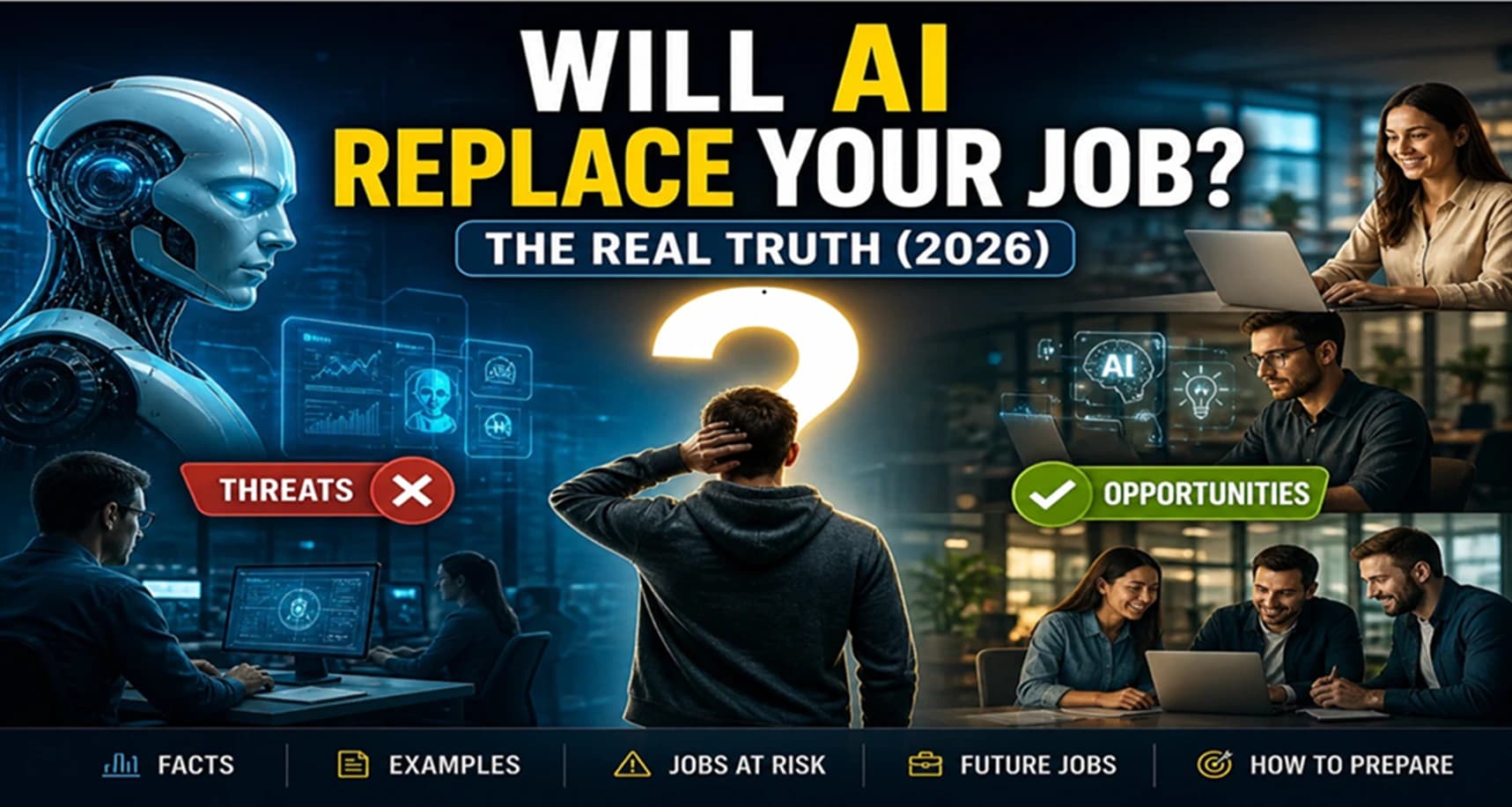
You’ve seen the headlines. "AI replaces 10,000 workers." "The end of coding is here." "Copywriters are obsolete." It feels like a storm is coming, and you’re standing right in the middle of it with nothing but an umbrella. Will AI replace your job? It’s the question that keeps millions of people up at night in 2026.
But here is the real truth: AI isn't a monster coming to eat your career. It’s a mirror. It’s reflecting back the parts of our jobs that were always robotic, repetitive, and frankly, boring. The real danger isn't AI—it's staying exactly where you are while the world shifts beneath your feet.
Table of Contents
- → What is AI? (Simple Explanation)
- → Why People Fear the Jobocalypse
- → Jobs at High Risk (The Red List)
- → Jobs That are SAFE (The Green List)
- → Detailed Risk Comparison Table
- → Real-Life Examples 2026
- → Pros and Cons of AI Integration
- → The Future of Jobs: 2026 & Beyond
- → Skills to Learn Right Now
- → Step-by-Step Career Protection Plan
- → Frequently Asked Questions
What is AI and How It Actually Works
Imagine you have a personal assistant who has read every book, seen every line of code, and watched every video ever made. That’s AI in 2026. But it’s not "conscious." It doesn't have a soul. It’s essentially a Prediction Machine.
In 2026, we’ve moved from "Chatbots" to "AI Agents." These agents don't just answer questions; they perform tasks. They can book your flights, write your reports, and even manage your emails. They work by spotting patterns. If a task is predictable, AI can do it faster and cheaper than any human.
💡 Quick Insight:
AI doesn't "think" like you. It calculates. While you use intuition and emotion, AI uses probability and data. This is why it can't replace the "Human Touch."
Why People Fear the Jobocalypse
The fear is real because the numbers are real. In 2024, IBM paused hiring for 7,800 roles that could be replaced by AI. By 2026, that number has grown globally. Why?
- Speed: AI can do in 2 seconds what takes a human 2 hours.
- Cost: An AI subscription costs $20/month; a human employee costs $5,000+/month.
- Consistency: AI doesn't get tired, doesn't need coffee, and doesn't have "bad days."
- Precision: In data-heavy tasks, AI makes fewer errors than humans.
Jobs That AI Will Replace (The Red List)
If your job involves sitting at a desk and moving data from Point A to Point B, you are in the danger zone. In 2026, these roles are being heavily automated:
1. Data Entry & Admin
AI agents can now scan, categorize, and enter data with 100% accuracy. The "clerical" worker is vanishing.
2. Basic Customer Service
If you follow a script, an AI can follow it better. Voice AI is now indistinguishable from humans on the phone.
3. Entry-Level Translation
Real-time translation earbuds and apps have made basic translation jobs nearly obsolete.
4. Routine Accounting
Tax prep and basic bookkeeping are now 99% automated by AI-driven finance software.
Jobs That Are SAFE from AI (The Green List)
Good news! There are things AI simply cannot do. In 2026, "High-Touch" and "High-Skill" jobs are thriving more than ever.
- 🏥
Healthcare Professionals
Nurses, surgeons, and therapists. AI can help diagnose, but it cannot provide the empathy and physical care a human needs.
- 🛠️
Skilled Trades
Plumbers, Electricians, and Carpenters. Robots aren't flexible enough yet to crawl under a sink or rewire an old house.
- 🎨
Strategic & Creative Leaders
AI can generate art, but it can't decide *why* a brand needs a certain direction or lead a team of people through a crisis.
The 2026 Job Risk Matrix
| Job Role | Risk Level | Reason | Future Scope |
|---|---|---|---|
| Customer Support | High | AI agents handle 90% of queries instantly. | Transition to CX Strategy. |
| Graphic Designer | Medium | AI generates images, but needs human direction. | Mastering AI-driven branding. |
| Software Developer | Medium | AI writes boilerplate code; humans solve architecture. | Becoming an AI System Architect. |
| Nurse/Doctor | Low | Requires physical empathy and complex judgment. | AI-assisted diagnostics. |
| Plumber/Electrician | Low | Dexterity in unpredictable environments. | Unchanged/High Demand. |
| Content Writer | Medium | AI writes SEO filler; humans write deep insight. | Niche Thought Leadership. |
Real-Life Examples: Companies Using AI Today
This isn't science fiction. In 2026, companies are already reaping the rewards (and dealing with the fallout) of AI integration:
Klarna (Fintech):
In 2024, Klarna announced their AI assistant handles the work of 700 full-time agents. By 2026, their customer support is almost entirely automated, leading to higher profits but fewer entry-level roles.
GitHub (Microsoft):
Copilot now writes nearly 60% of the world's new code. Junior developers are no longer hired to "write code"—they are hired to "review AI code."
Pros and Cons of AI in the Workplace
Pros (The Hope)
- ✅ 4-Day Work Weeks (due to high productivity)
- ✅ Elimination of "Drudge Work"
- ✅ Personalized Learning & Healthcare
- ✅ New Job Categories (AI Ethics, Prompt Eng)
Cons (The Danger)
- ❌ Rapid Job Displacement for Low-Skill Workers
- ❌ Increased Wealth Inequality
- ❌ Privacy & Surveillance Concerns
- ❌ Loss of Human Connection in Services
Future of Jobs in 2026 and Beyond
We are entering the era of the "Solopreneur." In 2026, one person with an AI can do the work that used to require a 10-person agency. This is both terrifying and empowering.
The job market isn't shrinking; it's *re-organizing.* We are moving away from "Knowing" (AI knows everything) and toward "Doing" and "Deciding." The person who can tell the AI exactly what to do and judge if it's correct is the new king of the economy.
How to Stay Safe: Skills to Learn Today
If you want to be un-replaceable, you need to lean into your humanity. Here are the 3 pillars of 2026 career safety:
AI Literacy (Don't Fight, Lead)
You don't need to be a coder. You need to know how to prompt, how to use AI tools like Claude, ChatGPT, and Midjourney to 10x your output.
Emotional Intelligence (EQ)
AI can't handle a crying customer or a frustrated team member. Negotiation, empathy, and leadership are your superpowers.
Niche Expertise
Generic knowledge is free. Deep, specific experience in a field (like bio-ethics, local law, or specialized engineering) is priceless.
Step-by-Step Plan to Future-Proof Your Career
Step 1: Audit Your Tasks. List everything you do in a day. If a task is repetitive, find an AI tool to do it for you *now*. Be the one who automates your job before someone else does.
Step 2: Spend 1 Hour a Week on AI. Use tools like ChatGPT, Gemini, or Claude. Experiment. Stay curious.
Step 3: Build a Personal Brand. AI can't replicate *you*. Whether it's on LinkedIn, a blog, or YouTube, make your voice heard. Authority is the ultimate job security.
Step 4: Network Like a Human. Coffee meetings, conferences, and genuine connections. The best jobs in 2026 are still found through people, not algorithms.
2026 Real-World Data Points
85M
Jobs Displaced
97M
New Roles Created
70%
AI Adoption Rate
*Source: Realistic 2026 projection based on WEF and McKinsey data trendlines.
Frequently Asked Questions
Q: Which jobs are most at risk from AI in 2026?
Jobs involving repetitive data entry, basic customer service, routine administrative tasks, and entry-level coding/translation are at the highest risk. AI agents can now handle these tasks with 99% accuracy.
Q: Will AI replace doctors and lawyers?
No, AI won't replace them, but it will change how they work. AI will handle diagnostics and legal research, while human professionals focus on complex judgment, ethics, and patient/client relationships.
Q: What skills should I learn to stay safe from AI?
Focus on 'Human-Only' skills: Emotional Intelligence (EQ), complex problem-solving, AI literacy, creative strategy, and physical craftsmanship that robots still struggle with.
Q: Is AI better than humans at creative writing?
In 2026, AI can write perfect grammar and follow structures, but it still lacks true lived experience, personal unique voice, and emotional nuance that makes a story truly human.
Q: Should I be scared of AI taking my job?
Fear is natural, but action is better. AI is more likely to replace 'tasks' rather than entire 'jobs.' By learning to work with AI, you become more valuable than someone who ignores it.
The Truth is in Your Hands
AI won't replace you. But a human using AI *will* replace a human who isn't. The future isn't scary if you're the one building it.